Application Description
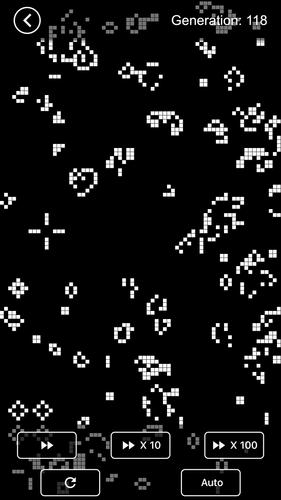
Created by mathematician John Conway in 1970, Conway's Game of Life is a classic simulation.
This Game of Life, an example of a cellular automaton, takes place on an infinite two-dimensional grid of cells. Every cell exists in one of two states: alive or dead. With each turn—referred to as a generation—the state of every cell updates based on the states of its eight neighboring cells. A cell's neighbors are those immediately adjacent to it horizontally, vertically, or diagonally.
The starting configuration is known as the first generation. The next generation is produced by applying the same set of rules to every cell on the board simultaneously, meaning all births and deaths occur at the same time. This rule-based process then repeats to form all subsequent generations. For any generation, the state of a cell in the following generation is governed by these straightforward rules:
A living cell remains alive only if it has exactly 2 or 3 living neighbors.
A dead cell becomes alive if it has precisely 3 living neighbors.
Naturally, numerous rule variations exist, based on different number combinations that dictate cell survival or death. Conway tested many of these alternatives before deciding on the specific rules we use today. Some rule sets cause populations to die off quickly, while others lead to unlimited expansion across the grid. The established rules sit very close to the boundary between these two extremes. As we observe in other chaotic systems, the most complex and fascinating patterns tend to emerge at this delicate balance point, where the competing forces of explosive growth and extinction perfectly counter each other.
What's New in the Latest Version 0.2.2
Last updated on Aug 3, 2024
Conway's Game of Life is a classic simulation created by mathematician John Conway in 1970.
Simulation



 Download
 Games like Conway's Game of Life